
Jimmy Page vs Tony Iommi – The Battle of Heavy Origins
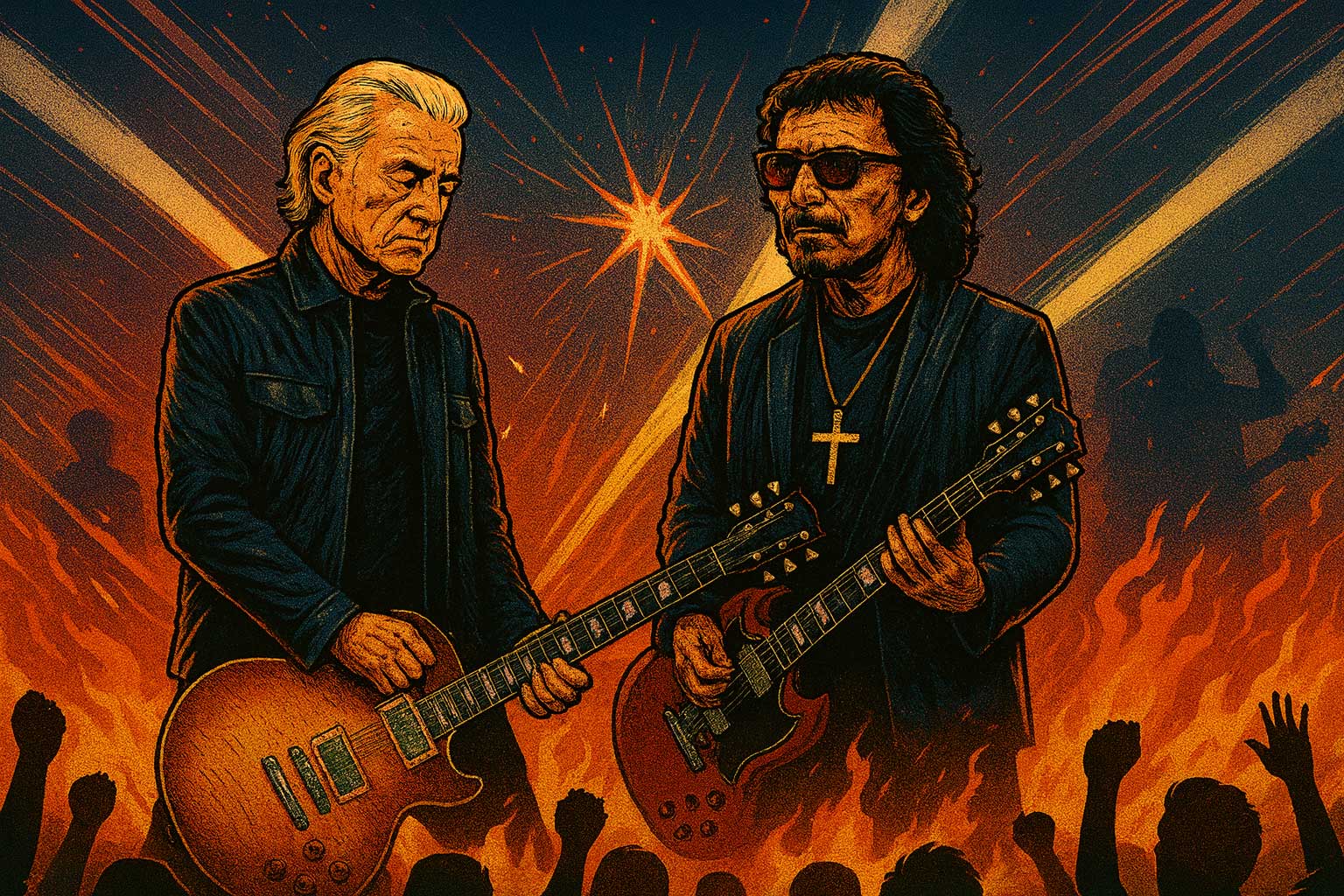
There’s a dimly lit club somewhere in London, circa 1969.
The amps are buzzing, the air’s thick with smoke and attitude.
On one side of the stage, a young Jimmy Page slings a sunburst Les Paul over his shoulder — all swagger, mystique, and razor-sharp precision.
Across town, in a darker corner of Birmingham, Tony Iommi plugs into a Laney stack that sounds like it’s forged in the steel mills themselves.
Two men. Two completely different worlds.
And yet, between them, they accidentally created heavy music as we know it.
Page gave rock its sex appeal — tone dripping with blues, reverb, and danger.
Iommi gave it muscle — the low-tuned menace that shook the earth.
Without Page’s elegance, metal might’ve lacked sophistication.
Without Iommi’s darkness, hard rock might’ve stayed polite.
This isn’t a competition — it’s a collision.
A meeting point where artistry met apocalypse, birthing everything from Led Zeppelin to Metallica.
The Foundations – Two Paths to the Riff Revolution
Both men were born from the same storm — post-war Britain, industrial grit, and the electric blues invasion — but they heard different things in the noise.
Jimmy Page – The Alchemist of Sound
Before he became the dark prince of Led Zeppelin, Jimmy Page was London’s most in-demand session guitarist.
He played on everything from pop hits to experimental records, quietly studying microphones, rooms, and tone.
While others focused on playing faster, Page obsessed over space — how sound bounced, how air moved.
He built Led Zeppelin’s sound around that obsession:
open tunings, reversed tapes, bowed guitars, and layers of Telecaster, Les Paul, and Danelectro tones, all sculpted through Marshall Super Bass heads and echo chambers.
He didn’t just play riffs — he designed them.
“I always saw the studio as another instrument,” Page once said.
“You can build a cathedral of sound if you know how to use the space.”
That’s why his riffs on Whole Lotta Love and Black Dog still sound bigger than most modern metal mixes — he wasn’t just playing guitar, he was building architecture out of noise.
Tony Iommi – The Architect of Heaviness
Meanwhile, in Birmingham, Tony Iommi was playing in factories — literally.
He was a welder by day, guitarist by night.
Then came the accident: two fingertips gone. Most would’ve quit; Iommi reinvented himself.
He crafted plastic caps for his fingers, switched to ultra-light strings, and tuned his guitar down to ease the tension.
The result? The world’s first detuned heavy sound.
His early experiments with Laney Supergroup amps, paired with the gritty resonance of Gibson SGs, created something primal and haunting.
When Black Sabbath dropped their self-titled debut in 1970, it didn’t just introduce heavy metal — it defined it.
“I couldn’t play like everyone else anymore,” Iommi recalled.
“So I made something that nobody else could play.”
Different Cities, Same Storm
While Page was recording in Olympic Studios, layering shimmering harmonics, Iommi was in a damp Birmingham basement shaking concrete walls.
One chased mysticism — the other, monoliths.
Yet both were searching for the same thing: a sound that hadn’t existed before.
The Sound – Light and Shadow in Six Strings
If Jimmy Page was the light — shimmering harmonics, echoing chambers, and seductive chaos —
then Tony Iommi was the shadow — detuned thunder, bone-rattling sustain, and riffs that felt like the earth splitting open.
Both took the blues and twisted it into something darker, louder, and infinitely heavier.
Jimmy Page – The Wizard of Air and Space
Page’s tone was never about perfection.
It was about magic.
His 1959 Les Paul “Number One” — gifted by Joe Walsh — became his sonic paintbrush, but his true instrument was the studio.
He stacked multiple guitar tracks through Marshall Super Bass, Hiwatt, and Vox UL4120 heads,
each mic’d at different distances to capture that signature Zeppelin “air.”
He’d record a single riff twice, pan them left and right, and let the natural phase differences create width —
a trick modern producers still try to replicate digitally.
Page’s setup on stage often looked simple:
-
Gibson Les Paul Standard #1 & #2
-
Danelectro 3021 (for “Kashmir” and open tunings)
-
Supro Coronado (used on early Zep records)
-
Tone Bender fuzz, Echoplex delay, Vox wah, and occasionally a Theremin for live chaos
But the magic wasn’t in the pedals — it was in how he played the amp.
Page worked the volume and tone knobs like an orchestra conductor, drawing texture and dynamics out of every phrase.
“I never wanted to sound clean,” he said once.
“I wanted to sound alive — on the edge of falling apart.”
That’s Jimmy Page in one sentence — beautifully unstable.
Tony Iommi – The Godfather of Low-End Doom
Iommi, on the other hand, built his kingdom on weight.
While Page added layers, Iommi stripped everything down — one guitar, one amp, one mission: make it heavy.
His early setup:
-
Gibson SG Special “Monkey”
-
Laney Supergroup 100W head
-
Laney 4×12 cabs with Celestion G12H 75Hz speakers
-
Dallas Rangemaster treble booster
-
Light-gauge Picato strings (.008–.032) for flexibility
He tuned down to C# standard, giving Sabbath their signature gloom.
Every riff became thicker, slower, and more menacing — not because of distortion, but because of gravity.
Listen to Iron Man or Children of the Grave — that’s not gain doing the work, it’s tuning, touch, and sheer willpower.
His playing is almost mechanical, but never soulless — each riff marches forward like a metal titan.
“My fingers changed the way I played,” Iommi once said.
“The sound followed my limitations. Turns out, that’s what made it mine.”
Two Sides of the Same Coin
Page’s riffs danced.
Iommi’s riffs crushed.
But they shared one sacred rule: feel first, theory second.
Both refused to be clean or polite.
Page explored open tunings and melodic tension; Iommi explored low frequencies and sustained terror.
Together, they turned rock into a battlefield —
one waging war with sonic light, the other with eternal darkness.
(Läs också vår artikel om Tony Iommi – The Godfather of Heavy Riffs
och hur han byggde sitt doom-sound från grunden.)
The Gear – The Tools That Forged Heavy Rock
You can tell everything about a guitarist by their rig — and Jimmy Page and Tony Iommi built empires from two completely different philosophies.
Page’s tone was all about texture and control, while Iommi’s was weight and necessity.
One layered guitars like brushstrokes; the other used a single riff to level cities.
Jimmy Page’s Arsenal – The Sonic Architect
If there’s such a thing as a “tone painter,” Jimmy Page is it.
Every era of Led Zeppelin had its own palette of instruments and amps — each chosen for how it interacted with the room, the mic, and his imagination.
Guitars:
-
1959 Gibson Les Paul Standard “Number One” – slim neck, custom wiring, high-output bridge pickup.
-
1959 Gibson Les Paul Standard “Number Two” – thicker neck, slightly brighter tone; often used live.
-
Fender Telecaster “Dragon” – his Yardbirds and Led Zeppelin I weapon, used on “Stairway to Heaven.”
-
Danelectro 3021 – for open tunings and haunting tracks like “Kashmir.”
-
Gibson EDS-1275 Double Neck – the ultimate rock flex, built for live transitions between 6- and 12-string parts.
Amps & Cabinets:
-
Marshall Super Bass 100W – his studio staple for Zeppelin II & IV.
-
Hiwatt DR103 – cleaner, chimey tones for live dynamics.
-
Vox UL4120 – used for layered overdubs and early sessions.
-
Supro Coronado – small amp with huge presence; likely used on “Good Times Bad Times.”
Effects:
-
Tone Bender MKII fuzz – thick, gnarly distortion with bite.
-
Echoplex EP-2 delay – for those ambient trails that made solos sound endless.
-
Vox Wah – used expressively, not excessively.
-
Theremin – because, well, Page liked scaring sound engineers.
Page’s signal chain was chaos disguised as genius — a messy pile of cables that somehow made history.
Tony Iommi’s Arsenal – The Sound of Steel
Where Page experimented, Iommi refined.
He found his sound early and never let it go.
His rig evolved in small steps, but the foundation has been the same for half a century: SG → boost → Laney → destruction.
Guitars:
-
Gibson SG Special “Monkey” (1965) – his holy grail. Custom cross inlays, John Birch modifications, and wound pickups for doom-thick mids.
-
Jaydee Custom SG “Old Boy” – relic’d to hell, main live guitar since the ’80s.
-
Gibson Iommi Signature SGs – fitted with Gibson Iommi Signature humbuckers (ceramic magnets for bite).
-
Epiphone Iommi SG Custom – tour backup, tuned to C# or D standard.
Amps & Cabinets:
-
Laney Supergroup 100W (1969–70) – the original Sabbath roar.
-
Laney TI100 Signature Head – his modern weapon, voiced after his old Supergroups with smoother highs.
-
Laney 4×12 Cabinets with Celestion G12H speakers – pure doom in wood and tolex.
-
Microphones: Shure SM57 and Sennheiser MD421 – close and off-axis, capturing the punch and warmth of molten tone.
Effects & Accessories:
-
Dallas Rangemaster Treble Booster / Laney TI Boost – adds grit and drive without mud.
-
ISP Decimator – subtle noise gate for live control.
-
Analogman OD (Tube Screamer mod) – for solos and sustain.
-
Strings: Picato (.008–.032) custom sets.
-
Picks: Dunlop Mediums (1.0 mm).
The result: pure, unfiltered power.
No fancy effects, no gimmicks — just tone forged by survival.
Two Philosophies, One Revolution
Page treated gear like a laboratory — every mic position, every knob mattered.
Iommi treated gear like a weapon — every riff was forged to hit harder than the last.
Both changed how the world thought about guitars.
Page made it mysterious.
Iommi made it monstrous.
And together, they created the blueprint for every rock and metal guitarist who came after them.
(Läs också vår artikel om Slash – Les Paul Fire and the Guns N’ Roses Tone
för att se hur arvet från Page och Iommi fortsatte in i 80-talets arenarock.)
The Influence – How Page and Iommi Split the World of Rock in Two
By the early ’70s, guitar music had a crossroads moment.
One path led to mystery, melody, and swagger — the other straight down into darkness and distortion.
Jimmy Page and Tony Iommi didn’t just inspire that split — they caused it.
The Church of Page
Jimmy Page’s followers built temples of tone — not with distortion pedals, but with dynamics and mystique.
His fingerprints are all over bands like Deep Purple, Aerosmith, Thin Lizzy, and later Guns N’ Roses.
You can hear his DNA in every player who ever tried to make a Les Paul sing rather than scream.
Page taught rock guitarists that tone wasn’t just about volume — it was about space, texture, and touch.
He pioneered open tunings, layering, and production as part of performance.
That became the foundation for hard rock’s cinematic side — music that felt dangerous and beautiful at the same time.
Even today, players like Jack White and Dan Auerbach still chase that Page mysticism — the imperfect, room-filling roar that sounds like alchemy caught on tape.
“He made the guitar sound human — but also godlike,”
said Joe Perry in a 2023 interview.
The Temple of Doom
If Page built a cathedral of light, Tony Iommi forged a fortress of shadow.
His riffs became scripture for heavy metal, doom, and stoner rock.
Without Iommi, there’s no Metallica, no Pantera, no Sleep.
He gave the guitar permission to sound ugly, slow, and terrifying.
Those drop-tuned, minor-key progressions became the foundation for every dark subgenre that followed.
From James Hetfield’s downpicked fury to Zakk Wylde’s pinch harmonics — everyone who’s ever chugged an open power chord in C# owes a silent debt to Iommi.
(Läs också vår artikel om James Hetfield – Downpicking King of Metallica
för att se hur Iommis rytmiska tyngd levde vidare i thrash-eran.)
The Dual Legacy
Page and Iommi didn’t compete — they completed each other.
Page taught us how to make the guitar speak; Iommi taught us how to make it growl.
One looked to mysticism, the other to machinery —
and together they defined what it meant to be heavy.
You can hear them both in modern rock — from Rival Sons to Ghost, from the fuzz-laden doom of Electric Wizard to the cinematic crunch of Royal Blood.
And while they may have started in the same smoky pubs of England,
their riffs traveled the world and built entire genres in their wake.
“Without Page there’d be no grandeur,”
said one critic.
“Without Iommi, there’d be no gravity.”
The Legacy – From the Blues to the Birth of Metal
When the smoke cleared in the early ’70s, two shadows stretched across the rock landscape — one mysterious and golden, the other dark and molten.
Jimmy Page and Tony Iommi didn’t plan it, but together they drew the blueprint for everything that came after: hard rock, heavy metal, doom, grunge, stoner, even punk’s edge.
They both started with the blues.
They both turned it up.
But where Page chased transcendence, Iommi built thunder.
Page’s Alchemy – Turning Sound into Myth
Jimmy Page didn’t just play riffs — he built worlds.
Every Zeppelin song felt cinematic, from the desert mysticism of Kashmir to the stormy swagger of Whole Lotta Love.
His touch made the guitar sound like a living being, breathing and bending through space and time.
He was one of the first to show that rock guitar could be intelligent without losing its danger.
He blurred the line between producer and performer — the scientist and the shaman.
And his influence lives on every time someone picks up a Les Paul and tries to balance chaos with control.
Iommi’s Iron Will – The Birth of the Heavy
Tony Iommi, meanwhile, turned personal tragedy into global legacy.
His damaged fingertips reshaped music history — forcing him to detune, invent lighter strings, and create a darker, slower, more powerful sound.
That one act — born of pain and adaptation — is literally the birth of heavy metal.
Without it, distortion would still be decoration, not destruction.
Iommi’s riffs — War Pigs, Iron Man, Into the Void — weren’t just songs.
They were blueprints for how to make guitars sound like war machines.
“Tony didn’t follow the blues — he forged steel with it,” one journalist wrote.
And that’s exactly what he did.
The Eternal Duo
Decades later, it’s impossible to talk about rock without mentioning them both in the same breath.
Page built the cathedral.
Iommi rang the bell.
Together, they transformed the guitar from a blues instrument into an engine of culture.
Every amp that hums, every riff that rattles your ribs — that’s their DNA.
They didn’t just inspire players.
They created disciples.
Still Echoing Through Time
Even in 2025, the echoes of Page and Iommi are everywhere.
The fuzz tones, the half-step detunes, the mysterious room mics, the slow-burn riffs — it all leads back to those two men.
Every new generation of players rediscovers them, thinking they’ve found something new…
only to realize Page and Iommi were already there fifty years ago.
Because this is what timeless sounds like:
the marriage of light and shadow, mysticism and machinery — the eternal hum of rock’s two greatest architects.
FAQ – Page, Iommi & The Birth of Heavy Rock
Who came first — Jimmy Page or Tony Iommi?
Jimmy Page hit the scene earlier as a session legend and Led Zeppelin’s mastermind (1968).
Tony Iommi formed Black Sabbath soon after (1969), turning his darker, detuned riffs into the blueprint for heavy metal.
Did Jimmy Page influence Tony Iommi?
Indirectly, yes.
Iommi has mentioned that Zeppelin’s raw power inspired him — but Sabbath’s sound came from necessity, not imitation.
Page painted with light; Iommi built with stone.
What guitars did they use?
Page’s signature axe: the 1959 Gibson Les Paul Standard “Number One”, plus his Fender Telecaster “Dragon” and Danelectro 3021 for open tunings.
Iommi ruled with the Gibson SG Special “Monkey” — modified pickups, ultra-light strings, and tuned down to C# to create that dark Sabbath weight.
What amps and pedals defined their tone?
Page relied on Marshall Super Bass heads, Tone Bender fuzz, and Echoplex delay for warmth and dimension.
Iommi ran Laney Supergroups, a Rangemaster treble booster, and almost no pedals — just pure amp saturation and attitude.
Who had the heavier sound?
Iommi, without a doubt — but Page made heavy sound beautiful.
That’s why rock needed both.
What’s their biggest contribution to guitar history?
Page gave us texture and atmosphere.
Iommi gave us power and permanence.
Together, they turned guitar music from rebellion into religion.
The Battle That Built Everything
No Jimmy Page, no mystique.
No Tony Iommi, no metal.
Between them lies the birth of every riff that ever mattered.
Page made the guitar seductive.
Iommi made it dangerous.
And in that tension — that perfect tug-of-war between control and chaos — rock found its eternal heartbeat.
Even now, every time you plug in, crank up, and lose yourself in feedback,
you’re standing in the space between Page’s fire and Iommi’s iron.
That’s not nostalgia.
That’s physics.